SMP vs Hair Transplant vs Medication: Which Is Best?
Pros, Cons, and Realistic Expectations
One of the most common questions people ask after researching hair loss solutions is:
“What actually makes the most sense for me?”
By the time someone asks that question, they have usually spent hours online comparing medications, hair transplants, topical products, supplements, laser devices, and scalp micropigmentation. The problem is that most information online feels either overly clinical or heavily biased toward selling one specific treatment.
At SMP Ink CDA, we approach these conversations differently.
The truth is that every hair restoration option comes with tradeoffs. There is no universal solution that works perfectly for every person, every hair type, or every stage of hair loss. Medications may help preserve existing hair. Hair transplants may restore real hair for the right candidate. SMP may improve the appearance of thinning hair, scalp visibility, bald areas, or a receding hairline without surgery.
The key is understanding what each option can realistically do.
The Main Difference Between SMP, Transplants, and Medications
Before comparing pros and cons, it helps to understand that these three options solve different problems.
Medications are typically used to slow hair loss, preserve existing hair, or support regrowth for some people.
Hair transplants are surgical procedures that move existing hair follicles from donor areas to thinning or bald areas.
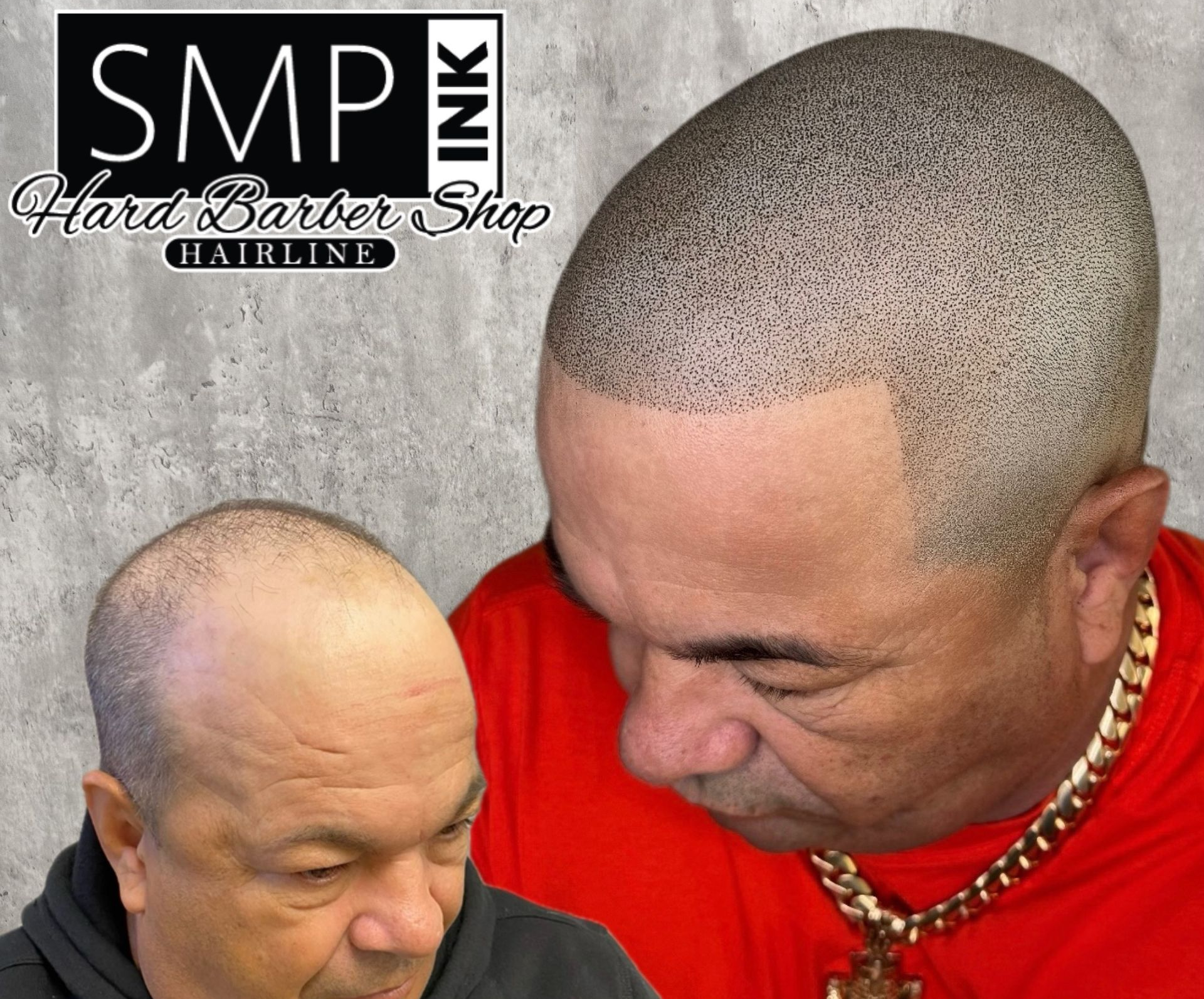
Scalp micropigmentation is a non-surgical cosmetic procedure that creates the appearance of natural hair follicles, fuller density, or a closely shaved scalp.
That difference matters because someone searching for actual hair regrowth may need a different solution than someone who wants to reduce scalp visibility or create the appearance of a stronger hairline.
A successful hair loss plan begins with a clear goal:
- Do you want to slow future hair loss?
- Do you want to regrow actual hair?
- Do you want to improve visible scalp contrast?
- Do you want a cleaner shaved look?
- Do you want to avoid surgery?
- Do you want to reduce daily maintenance?
- Do you want a solution that improves appearance without waiting months for regrowth?
Once you know the goal, it becomes easier to compare your options.
What Are Hair Loss Medications?
Hair loss medications are commonly used for pattern hair loss, especially androgenetic alopecia, also known as male or female pattern hair loss.
Two of the most well-known options are:
- Minoxidil
- Finasteride
Minoxidil is available over the counter in liquid, foam, and shampoo forms. Mayo Clinic notes that minoxidil may help many people regrow hair, slow hair loss, or both, but it can take at least six months to prevent further loss and begin regrowth. Continued use is generally needed to maintain benefits.
Finasteride is a prescription medication commonly used for men with male pattern hair loss. Mayo Clinic states that many men taking finasteride experience a slowing of hair loss, and some may show new hair growth, but continued use is needed to retain any benefits.
Medications can be valuable for the right person, especially when the goal is to preserve existing hair or slow progression. However, they are usually not instant solutions. They require consistency, patience, and medical guidance when appropriate.
Potential Benefits of Hair Loss Medications
Hair loss medications may help some people:
- Slow progression of genetic hair loss
- Preserve existing hair
- Improve thickness
- Support partial regrowth
- Delay the need for more involved procedures
- Maintain results after a hair transplant
For people in the early stages of hair loss, medications may be an important part of a long-term plan.
Potential Downsides of Hair Loss Medications
Hair loss medications can also come with tradeoffs, including:
- Ongoing daily or routine use
- Results that vary from person to person
- Months of waiting before progress is clear
- Continued cost over time
- Possible side effects
- Hair loss resuming if treatment is stopped
- Limited cosmetic improvement for advanced thinning
This does not mean medications are bad. It means they need to be evaluated realistically. They may be a strong option for someone trying to preserve hair, but they may not fully restore a receded hairline, cover a bald crown, or eliminate visible scalp contrast for every person.
What Are Hair Transplants?
Hair transplants are surgical procedures that move hair follicles from donor areas, usually the back or sides of the scalp, into areas affected by thinning or baldness.
Modern transplant techniques have improved significantly. For the right candidate, a transplant can yield impressive results because transplanted follicles can grow hair in the treated area.
Hair transplants can work particularly well for people with:
- Stable hair loss patterns
- Strong donor hair
- Realistic expectations
- Moderate recession
- Adequate scalp health
- A willingness to go through surgery and recovery
- Enough budget for the procedure and possible future maintenance
However, hair transplants are not as simple as many online ads make them appear.
Mayo Clinic explains that hair transplant surgery removes hair from a part of the head that has hair and transplants it to a bald spot. A transplant redistributes existing hair; it does not create new donor follicles. If hair loss continues, additional procedures may be needed to cover areas that thin later.
Potential Benefits of Hair Transplants
Hair transplants may offer:
- Actual hair growth in treated areas
- Natural styling options when successful
- Long-term improvement for the right candidate
- A strong option for certain recession patterns
- Compatibility with medications and SMP when needed
For someone with strong donor hair and stable hair loss, a transplant may be a worthwhile solution.
Potential Downsides of Hair Transplants
Hair transplants also come with important considerations:
- Surgical procedure
- Healing and recovery time
- Higher financial investment
- Reliance on donor hair supply
- Possible need for multiple procedures
- Risk of visible scarring
- Variable density outcomes
- Hair loss can continue around transplanted areas
- Final results may take many months
Mayo Clinic notes that transplanted hair often falls out about a month after surgery, begins to grow again after three to five months, and may not show best results until about eight to twelve months after the procedure.
At SMP Ink CDA, we regularly meet clients who had transplants years earlier and later pursue SMP to improve density, camouflage scarring, or create a more complete overall appearance.
What Is Scalp Micropigmentation?
Scalp micropigmentation, commonly known as SMP, is a non-surgical cosmetic procedure designed to improve the appearance of hair loss.
Unlike medications or transplants, SMP is not attempting to grow hair.
Instead, SMP uses specialized pigments and scalp-specific techniques to replicate the appearance of natural hair follicles. The goal is to create the visual impression of fuller density, reduced scalp contrast, a more defined hairline, or a closely shaved scalp.
For many clients, the appeal of SMP lies in its predictability. They are not waiting months to find out whether a medication is working. They are not wondering whether transplanted grafts will survive. They are directly improving the visible appearance of hair loss.
What Can SMP Help With?
SMP may help improve the appearance of:
- Receding hairlines
- Thinning crowns
- Bald spots
- Diffuse thinning
- Widening part lines
- Visible scalp contrast
- Hair transplant scars
- Alopecia-related thinning
- Patchy hair loss
- Closely shaved scalp styles
For men, SMP for men can recreate the look of shaved follicles, restore the appearance of a hairline, reduce scalp visibility, and create a cleaner, more intentional style.
For women, SMP for women is commonly used to reduce visible scalp contrast around the part line, crown, temples, or thinning areas.
For people with thinning hair but existing coverage, SMP density fill can create the appearance of fuller density by reducing contrast between the scalp and surrounding hair.
Potential Benefits of SMP
SMP may offer:
- Non-surgical treatment
- No hair grafts or incisions
- Minimal downtime compared to surgery
- No daily application like fibers or concealers
- More predictable cosmetic improvement
- Useful for men and women
- Can help with hairlines, density, bald areas, and scars
- Long-lasting results with touch-up options
- Can complement hair transplants or medications
SMP is especially helpful for people whose primary goal is appearance rather than biological regrowth.
Potential Downsides of SMP
SMP is not the right solution for every goal.
Important limitations include:
- It does not regrow hair
- It does not stop medical hair loss
- It does not replace diagnosis or medical treatment
- It may need future touch-ups
- Results depend heavily on the provider's skill
- Hairline design and pigment selection must be done carefully
- It improves appearance rather than changing the biology of hair loss
Honesty is important. SMP is powerful because it does what it says it does: it improves the appearance of hair loss. It should not be marketed as a cure for hair loss.
SMP vs Hair Transplant
SMP and hair transplants are often compared, but they are very different solutions.
A hair transplant is a surgical procedure that moves real hair into thinning areas. SMP is a non-surgical cosmetic procedure designed to create the appearance of follicles or density.
A transplant may be better for someone who wants actual hair growth, has strong donor hair, has stable hair loss, and is comfortable with surgery. SMP may be better for someone who wants a lower-maintenance cosmetic solution without surgery, graft-survival uncertainty, or a long recovery.
Some clients use both. SMP may help improve the appearance of density after a transplant or camouflage transplant scars.
SMP vs Medication
Medication and SMP serve different purposes.
Medication is designed to slow loss, preserve existing hair, or support regrowth. SMP is designed to improve appearance.
A person may use medication to preserve hair while choosing SMP to reduce visible scalp contrast. Another person may avoid medication and choose SMP because they want a non-surgical cosmetic solution that does not require long-term daily use.
Neither option is automatically better for everyone. It depends on the person’s goals, medical history, expectations, and comfort level.
Hair Transplant vs Medication
Hair transplants and medications are often used together.
A transplant can move hair into thinning areas, while medication may help slow future loss of the surrounding native hair. Without long-term planning, someone may restore one area surgically while continuing to thin in nearby areas over time.
This is one reason transplant candidates should think beyond the first procedure. The question is not only, “Can I restore this area now?” It is also, “How will my hair loss progress over the next five, ten, or fifteen years?”
Comparing Cost, Maintenance, and Recovery
Every option comes with a different type of investment.
Medications
Medications usually involve a lower upfront cost but require ongoing use. Over time, monthly costs can accumulate. Maintenance is consistent and long-term.
Hair Transplants
Hair transplants often involve the highest upfront cost and the most recovery. They may also require additional procedures if hair loss continues.
SMP
At SMP Ink CDA, most SMP treatments range from approximately $2,000 to $3,500, depending on the amount of hair loss being addressed. Financing options are also available through Cherry Financial for qualified clients.
SMP is typically less invasive than surgery and does not require the same daily maintenance as fibers, concealers, or topical products.
Which Option Looks the Most Natural?
A natural-looking result depends less on the category of treatment and more on proper candidate selection, planning, and provider skill.
Medications can look natural if they successfully preserve or regrow the person’s own hair.
Hair transplants can look natural when donor planning, graft placement, density, and hairline design are handled well.
SMP can look natural when pigment, depth, dot size, spacing, density, and hairline design are performed correctly.
The risk with any hair loss solution is unrealistic expectations or poor execution. A transplant can look unnatural if the hairline is poorly designed. SMP can look artificial if it is too dark or dense. Medications can disappoint if someone expects a full restoration from a product that only slows progression.
The best result comes from matching the treatment to the person.
Can SMP Look Natural?
This is one of the biggest concerns people have initially.
Many people hear phrases like “hair tattoo” and imagine something fake, blue, dark, or obvious. Properly performed SMP should look subtle, natural, and virtually undetectable in normal everyday life.
At SMP Ink CDA, treatments are performed in a professional clinical setting using specialized pigments and techniques developed specifically for scalp work. The goal is not for people to notice the procedure. The goal is for the client to look more balanced, confident, and natural.
What About Pain and Recovery?
Medications involve no procedure, although side effects may be a concern for some individuals.
Hair transplants are surgical procedures and involve healing, scabbing, shedding, waiting, and downtime. The final result can take many months to fully develop.
SMP is minimally invasive compared to surgery and is manageable for most clients. Many describe sessions as mild irritation or light scratching. Some clients even relax enough to fall asleep during treatment.
Recovery is also generally simpler than surgical restoration, although clients still need to follow aftercare instructions carefully to protect their results.
How Long Does SMP Last?
SMP is designed to be long-lasting.
Most clients can expect results to maintain their appearance for several years before eventually considering a touch-up. Longevity can vary depending on skin type, sun exposure, lifestyle, aftercare, and natural pigment softening over time.
At SMP Ink CDA, clients receive:
- One-year warranty coverage
- Lifetime support
- Future touch-up treatments at reduced pricing
- Ongoing aftercare guidance
Can These Treatments Be Combined?
Yes. Many people combine hair loss treatments.
Someone may use medication to slow progression, get a transplant to restore real hair in specific areas, and use SMP to improve the appearance of density or camouflage scarring. Another person may skip surgery and choose SMP as their primary cosmetic solution. Someone else may start with medication and later add SMP if visible thinning remains.
Combination approaches can work well when each treatment has a clear purpose.
The mistake is expecting one option to do everything.
Which Option Is Best?
There is no one-size-fits-all answer.
The best option depends on your cause of hair loss, goals, budget, timeline, tolerance for maintenance, comfort with surgery, and expectations.
Medication may be best if you want to slow progression or preserve existing hair.
A hair transplant may be best if you want real hair growth, have strong donor hair, and are comfortable with surgery.
SMP may be best if you want a non-surgical, lower-maintenance cosmetic solution that improves the appearance of hair loss directly.
At SMP Ink CDA, we strongly believe clients deserve honest conversations, not exaggerated promises. Hair loss is emotional enough without being sold unrealistic expectations.
Choosing the Right Hair Loss Solution
Hair loss affects people differently. For some, it is a minor annoyance. For others, it quietly impacts confidence, self-image, relationships, career confidence, and daily quality of life for years.
The encouraging part is that modern hair restoration options have never been more advanced or accessible. Whether someone chooses medication, surgery, SMP, or a combination of approaches, the goal should always be the same:
Finding a realistic solution that helps them feel more confident and comfortable in their own skin again.
At SMP Ink CDA, we help clients throughout Coeur d’Alene, North Idaho, Spokane, and the Inland Northwest explore scalp micropigmentation as a non-surgical option for improving the appearance of hair loss, thinning hair, scalp visibility, and hairline recession.
Frequently Asked Questions About SMP Treatment and Hair Loss
Is SMP better than a hair transplant?
SMP is not automatically better than a hair transplant. They serve different goals. A hair transplant moves real hair into thinning areas, while SMP creates the appearance of follicles or density without surgery. The better choice depends on your goals, donor hair, budget, and comfort level.
Is SMP better than minoxidil or finasteride?
SMP and medications do different things. Minoxidil and finasteride may help slow hair loss or support regrowth for some people. SMP improves the appearance of hair loss cosmetically but does not regrow hair.
Can you combine SMP with a hair transplant?
Yes. Some clients use SMP after a hair transplant to improve the appearance of density, blend thinning areas, or camouflage transplant scars.
Does SMP stop hair loss?
No. SMP does not stop hair loss or medically treat the cause of thinning. It creates the appearance of fuller density, natural follicles, or a closely shaved scalp.
How much does SMP cost compared to a hair transplant?
At SMP Ink CDA, most SMP treatments range from approximately $2,000 to $3,500. Hair transplants often cost significantly more, especially if multiple procedures are needed.
Which hair loss treatment has the least downtime?
Medications have no procedure-related downtime. SMP usually has minimal downtime compared to surgical hair restoration. Hair transplants involve more recovery and a longer wait for final results.
Does SMP look natural?
Properly performed SMP should look natural and subtle. Results depend on pigment selection, technique, hairline design, dot size, depth, and provider experience.
Is SMP a good option for women?
Yes. SMP can help women reduce visible scalp contrast around the part line, crown, temples, or other thinning areas. It is commonly used to create the appearance of fuller density.